
We have had a busy time in the social sciences department this week. Students have had the opportunity to attend a number of super curricular webinars in fields related to psychology, sociology, criminology, nursing and law.
Tuesday’s lecture covered Minority Influence – one of our year 12 topics in psychology. Dr Ian Norman from The University of East Anglia argued ‘Social norms are prevalent throughout society and govern many human behaviours. Those who don’t follow these norms can face social sanctions. Yet, we regularly see attitude and behavioural change over time ….’ He linked this to how climate change and environmental concerns have become a mainstream political issue over time, and how well minority influence can account for this change in attitudes and behaviour.
Tuesday’s lecture covered Minority Influence – one of our year 12 topics in psychology. Dr Ian Norman from The University of East Anglia argued ‘Social norms are prevalent throughout society and govern many human behaviours. Those who don’t follow these norms can face social sanctions. Yet, we regularly see attitude and behavioural change over time ….’ He linked this to how climate change and environmental concerns have become a mainstream political issue over time, and how well minority influence can account for this change in attitudes and behaviour.
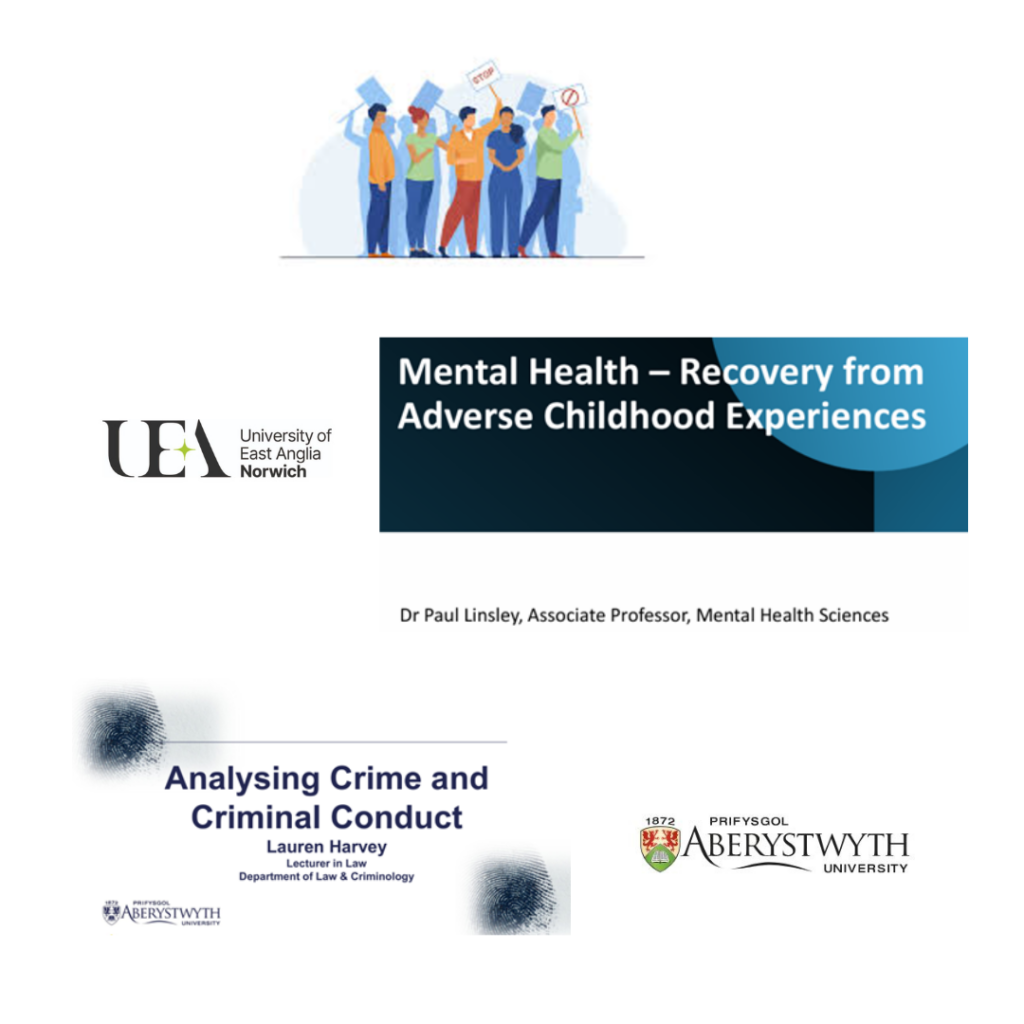
On Wednesday we joined a fascinating debate on law/criminology delivered by Lauren Harvey LLB Hons Aberystwyth University. Lauren asked ‘what does an effective criminal justice system look like and how easy is this to achieve?’ We looked at why ‘crime’ is so difficult to define and to legislate for, and how societal attitudes to crime vary. Lauren engaged with the audience in a discussion of questions such as: Should assisted dying being legalised and should a 10-year-old be criminally responsible for their actions? Should we adopt Good Samaritan laws? Can killing someone ever be the right thing to do?
A number of students hoping to pursue a law degree and those applying for psychology, criminology and sociology attended this fascinating debate.
Thursday’s lecture was related to Mental Health – Recovery from Adverse Childhood Experiences delivered by Dr Paul Linsley, Associate Professor, Mental Health Sciences at UEA.
Adverse Childhood Experiences (ACE) are a major public health concern and Paul began by introducing ACE and their long-term impacts on mental health, emotional regulation, relationships and socio-emotional development. The session moved on to consider trauma-informed care (TIC) and focused particularly on the Developmental-Reparative Model which integrates trauma neuroscience, developmental psychology and, critically, Emotional Intelligence theory.
Thank you to all the students who attended and to the sixth form team for their support.